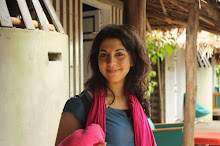
After insisting for days, I finally managed to set an interview with Professor Yunus. What a beautiful way of closing up such a wonderful adventure. We spoke about Social Business and Grameen Bank work in this field in his office. He wondered about my trip to Bangladesh… I tried to let him know about my passion for social business and for so many other concerns that his writings arose in my mind.
I was very grateful for his time as it is very difficult to have a meeting with him (especially for an Intern) as he is a very busy man who is always travelling.
I am very pleased to have had the chance of meeting Yunus, it was an incredible opportunity. I hope I see him again some day.
domingo, 15 de febrero de 2009

viernes, 13 de febrero de 2009
Atesham

The journey is about to end, but let me introduce you to a very important person who accompanied me during my stay in Bangladesh: Atesham, my Grameen Bank Coordinator.
Atesham started working at Grameen Bank from the very beginning; that’s why he knows all about it and feels part of the Institute’s philosophy. It is amazing to hear what he has to say. Every word of speech transmits his passion for the cause.
He began working for the bank in a very poor area of Bangladesh, a great challenge for someone that had just finished his studies. First he was Second Officer for a branch and he was rapidly promoted to Branch Manager. At those times the conditions at villages were much poorer than they are now. There were no streets and the land kept flooded by summer rains.
Grameen employees had to walk or ride a bike to get to the center meetings. Atesham traveled around the village for weeks, visiting the inhabitants, schools, mosques and markets to present the Grameen project of small loans. Nowadays, Grameen is widely known in Bangladesh (it is the most important bank within the country) and the world, but it wasn’t easy at the beginning to convince the poorest people of the country that the opportunity that GB offered was unique and convenient for their situation. Many groups rose against Grameen: wealthy inhabitants, religious groups and political parties, etc. But Atesham succeed creating a bound with them.
Not many months passed before this Branch Manager gathered 1.000 members. His main aim was to relieve the situation of the disadvantaged people of his country. He made people understand that they could have a better life if they got together with a common goal, themselves with the aid of loans and work within community and Grameen Staff. The building of streets was a solid example of this. The Government could only provide the money for material but no for labor. Atesham together with villagers decided to do the work themselves as volunteers to build streets so as to move transit around more easily and to open market shops. Streets were ready in two months. He also managed to import 1.000 latrines for the population and he also arranged for their installation.
He shared with me some of his techniques to mix with villagers, to get to know their stories to help them in a better way. It’s all about setting up deep bonds with people and feeling true concern for them.
Knowing the people you lend the money is not enough, you have to know their family, business and desires. Soon Atesham became a role model for each person. Everybody turned to him for any problem. His never-ending work and his constant availability to help, was well known in the community. I think his idea of studying to be a Vet was great, as one of the most important problems the population has to deal with everyday is Animal Care. Many Villagers work mainly as breeders for cows, ducks, etc., so he helped them in that.
When he was transferred to another area, the number of Grameen borrowers was 3.000. This man left a mark and changed the lives of thousands of people.
I was deeply moved after I listening to him. He transmits a vivid energy when he talks about his work in Grameen, and it’s beautiful. He is an example of what we can achieve if we truthfully believe in what we do. I was very lucky that he was my coordinator.
lunes, 9 de febrero de 2009
Slam at Dhaka


Today I visited one of the poorest areas of Dhaka, what they call “Slum”, as in English. It is a densely populated, very dirty and poor area. Houses are very tiny. I felt very bad after I saw the way these people live. It is a very sad image. Hundreds of people sharing the same latrine and the same water pump.
I also visited a community center that belongs to Padakhep, one of the most important NGO in Bangladesh, partner of Grameen. This NGO is focused on microfinance projects in Dhaka City. They have 2.5 millions borrowers in Bangladesh and 5 millions members. This NGO has a very interesting program for homeless children. During the day they offer them the chance to learn school subject and take care of their health. They offer health-care and psychological aid and a variety of vocational courses to teach any kind of job. Only girls can stay overnight, today 30 of them sleep there. It is a very dangerous area for them to wander around. They told us that they are in danger of white slave trade, so they keep them away from this awful destiny.
In the “Slum”, I had the chance of participating in a borrowers meeting that took place at a borrower’s house. We were 20 women in a very small room. They all accepted loans for different purposes: textile, popcorn machines, saris purchasing, etc. Most of them came from the outskirts of Bangladesh seeking work in the city. None of them think of going back to their village. A few of them attended school for some years and have now became housekeepers.
I was really shocked by a 15 year old girl that had a baby already. She married at 14 and today she has the responsibilities of a mom and a house. Women are not legally authorized to marry until they are 18, but in this country, tradition is way much stronger than law.
This poverty doesn’t seem strange to me. Going along the streets of Dhaka I keep in mind the streets of Buenos Aires as well. Maybe, we have the advantage, that Buenos Aires is more picturesque while here, the city is polluted, grey with a tint of sadness in the eyes of its inhabitants. Here there are some pictures to illustrate what I mean.
jueves, 5 de febrero de 2009
My stay in Katigram Manikgonj Branch


My experience in this second trip, was beautiful. I think that I have started to understand better the work done by Grameen and their staff. The situation of the majority of women has improved a lot in the last 30 years, although there is a vast difference of status between women and men. Women are in charge of paying back the loan and going to centre meetings every week, while men run the business. Some women tell us that both decide at home, but men have the last word. Nowadays, women gain a daily space in community; they leave their houses, share time everyday with other women and also have to pay the loan payment. There is much to do for women and their situation. But cultural legacy here is very strong. For instance, women do not eat together with their men, they serve the meal and wait for men to finish, then they start eating the leftovers (I witnessed this at two branches). As a woman, seeing the way they are treated is harsh and greatly annoying. It is impossible to get used to that, because it is really unfair.
In this occasion I was able to enjoy the landscape, we had long walks through rice fields and tobacco plantation. The view was amazing, a rest for the eye and mind. It was really pleasant. Those sceneries invite me to think deeply about many things.
I met many interesting characters in this trip. One of the astonishing things was the generational gap in the villages. Most parents (borrowers from Grameen Bank) send their kids to school and some make the effort to send them to College too. We were able to interview 3 girls that received a Grameen scholarship to start their first year at the university. They will receive 150 tk. monthly (USD 2) during 2009. That is not enough obviously, so their family pays for the rest. This scholarship is given for one unique opportunity, so the rest of the study will depend on the financial situation of their parents. Most parents did not finish primary school, some did not go to school at all, but they do understand the importance and privilege of a good education for their kids. They dream of their kids becoming doctors, teachers, engineers, etc.
Poverty is everywhere, their houses are modest but they manage pretty well with what they have, because here, little is enough. I think they are very good administrators.
To put my impressions and thoughts into words becomes more and more difficult each time. I apologize. During my stay in Tangail, I felt for the fist time in my life that I needed nothing else. It was a very special moment, I didn’t need anything: I had all I needed. There I was, sitting next to the center manager, listening to the borrowers stories and I felt complete, more human than ever. It is hard to go back to reality after such a beautiful and amazing feeling. I wonder which the true reality is…
We also had a lot of interaction with kids. I found an excellent Bangla Shikok (teacher) who taught me to write numbers in Bangla. After half an hour of practice, I can say that I learnt quite well. My teacher was only 13 but he was satisfied with his work.
I also discovered that I have a soft spot for Bangladeshi babies; they are the most beautiful little persons that I’ve ever met in my life. Some pictures to enjoy here.
domingo, 1 de febrero de 2009
Some pictures


Asala molecum!
Tomorrow I’m leaving for Katigram Manikgonj (west of Bangladesh) so I’m leaving you a picture of Dhaka that I took from the terrace of the hotel and some pictures of Solonga villagers. Maybe in one picture you can’t find me, I’m part of the group!
See you on Thursday! Poré deka jobe!
Bangladeshi Wedding


Today I was lucky enough to be at a Bengali wedding. There were 1,000 guests in a huge salon full of colorful lights. The bride was gorgeous and both seemed very happy. We had a Bangladeshi meal, spicy but very delicious. The best part of the evening was the getting ready. We went to the house of a friend’s aunt in the evening and then we went shopping together with her daughter. We bought beautiful Saris with accessories (a t-shirt, trouser to wear underneath the sari and a pair of shoes). Then we went back to the house and got ready for the event. We have make up put on our faces and our hair was done up. The ladies of the house helped us to put on the sari. It’s a difficult job.
Imagine a very long piece of material wound round your body many times. We spent an hour an a half dressing up. The women who helped us were very kind and sweet.
We had a nice moment of intimacy these women, although our cultures are different, we felt the complicity of the genre and we laughed a lot.
That was a very interesting evening. Here are some photos to see the clothes and the wedding.
viernes, 30 de enero de 2009
Knowing the borrowers


In my trip to Solonga I attended many borrowers´ meetings, 5 female centers and one male center (97% of the Grameen borrowers are women). At these meetings the Center Manager collects weekly loan payments and discusses with borrowers any problems that may have arisen during the week. The meeting is held once a week at the center house (a small house made of straw and cane, a table and many benches). The Mgr. sits behind the desk and borrowers sit in groups in front of him. The first bench is always the bench of honor. Normally the Center leader sits there and she is in charge of starting and finishing the meeting as it is stipulated by Grameen rules. It is a formality that is divided into three steps: stand up, rise your right hand (in Bangladesh you always have to use your right hand, to eat, thank, etc.) and then sit again.
Once the greeting was over, we introduced ourselves in Blanga…yeah (very funny because women were surprised to hear us speaking their language). I must say that I learnt a lot in those 4 days. Then our questions began: we asked them about their life, loans, history, desires, and plans for the future. At the end, they asked us about our country of origin.
At the meetings some women talked with confidence while others were shy hiding their mouth behind their veil. Most of them have been GB borrowers for a long time. Their lives have changed a lot in the last 20 years, since their first loan. One of the borrowers told us that, at the beginning, they were scared taking the credit, learning the rules, and memorializing them, being totally illiterate. But after 7 days of training, they became Grameen Bank borrowers. At that time they lived at a shack and most of them didn’t even own the land where they lived. Their husbands worked the land and have a very low income. With time and Grameen credits they started their own business and built their own house (now made of straw). Today they do their best to have their kids educated and to repay the bank. Their life has changed dramatically. They still have a poorly life from our point of view but, actually, it is a great step forward for them.
Some women were luckier than others. Some continued progressing while others had to take flexible loans to continue paying the bank.
The area I visited suffers from floods. The river rises high in summer and water covers the roofs of houses. Every year people have to rebuild their house and their lose assets (cattle, crops, etc). The Government cooperates reconstructing the area by spending billions of USD per year. Nevertheless, they keep working every year, taking credits to increase business and looking forward to a better future. They know that floods will come so they try to prepare themselves every year.
Borrowers´ kids (older that 6 years) must attend school, that’s a requirement of Grameen. Most of the mothers are illiterate but the following generation is literate. Kids who do not attend school work in the family business. These children belong to big and less educated families. In these centers, the situation is much more.
Grameen Bank offers many types of loans: basic loans, micro enterprise loans (for bigger business that requires more money), loans for higher education (school and university), loans for house construction, scholarship for the best student, etc.
Women are the connection between the family and the bank. They are responsible for attending the meeting and repaying the loan weekly (another bank’s requirement). Grameen believes that women administrate money better than men do. Women will spend money on family welfare and development, and that is the bank’s main philosophy.
There was a great feeling of union and community in the atmosphere. Everyone cared about each other. Borrowers helped each other when someone couldn’t afford the repayment. Bank works through peer pressure. All members must be updated with repayments, so that everybody can keep getting the loan. The community is really concerned about the sustainability of refunds.
It was a great pleasure to meet these borrowers, their stories, and their future plans. Some of them invited us to go to their houses and very proudly showed us their homes. Here there are some pictures for you to know them too.
I should say that this was not an easy goodbye. Some women were very touched when they told us their stories, they were thankful for receiving people from other countries who had come to their homes and had listened to their anecdotes. And so were we with each tale and every sweet look from these women. The oldest women wished us a long life and patted our heads as a blessing. I am so grateful to everyone for having me at their homes and sharing their stories with me. The world hides wonderful stories in isolated villages…I heard some of these stories and I feel very lucky for that.
More pictures from Solonga


Here there are more pictures of this incredible place. The landscape of Solonga is stunning, full of green (rice pads) and fresh air. At night silence and stillness allow me to enjoy the stars… something impossible in Dhaka.
The girl with beautiful eyes is Nurjahan; her name in Bangla means “light of the world”. Her mother was closing her account at the bank because her husband will travel to Lebanon to work and will send them money monthly so, she will not have money to repay the bank weekly.
Struggling Member Program


Grameen Bank has developed a program for beggars: Struggling Member Program. Every center at GB is responsible for recruiting beggars from villages to give them the chance of becoming borrowers of Grameen. They have a very different treatment. They are given a loan with no interest at all. They have no deadline to return the money. The idea is to encourage them to start some activity that generates money. They usually take the loan to grow something if they own a piece of land or they buy small items to sell door-to-door service. The proposal is for them not to beg anymore but it isn’t a mandatory request. Some of them quit begging and some do it one or two days a week.
I was lucky to meet many members of this project. Their life story is very tough but their spirit and strength is unbelievable. I truly admire them.
Most of them are women who lost their husbands many years ago. Their kids are poor too and they cannot support them economically so they are abandoned. Poor women that become divorced or are widows in this society become, most of the times, homeless. They begin to beg. Everyone in the community knows them.
Once they get into the program, they are adopted by a “guardian”: someone who takes care of them, not for charity (Grammen does not support charity), but to be aware of their needs.
In my trip to Solonga I met a successful case: Ravier Katun. This woman entered the program and after 3 years she became a borrower from the bank. She quit begging and now she has her small business of selling poultry. She has been a member of Grameen Bank for 5 years now, for the last 2 as a basic borrower. Her husband died in the 70’ leaving her with 4 daughters. She used to live at the same place where she keeps her birds now. She wants to buy a cow because she says she has got bored with chicken business. The manager has promised that she will receive the loan to buy it. The whole community is very proud of her achievement. She is a great model.
I met another program member: Giolimon. A 70-year-old woman who is still a member of the program, but her life has improved considerably. She was very sweet with us; she was moved as she shared her story with people from other countries. She wished us a long life in a very affectionate way as elderly people frequently do here.
I believe this is a very good and valuable program. Many beggars are leaving streets to be able to undertake their own project. It is a huge step, very hard, but they rely on the support of the community. It is so great to see these people so united. They are always helping each other with a great community feeling.
Here are some pictures of program members. I believe they are great fighters.
jueves, 29 de enero de 2009
Social Business


I am back in Dhaka, very proud of the incredible women I met. I am so happy that words are not enough to describe my feelings.
I was 4 days in the north of the country. I visited Bogora and Solonga. The itinerary began in Bogora, where Grameen has to 2 social companies. Let me explain a bit about this new concept developed by Prof. Yunus. According to Yunus, it is possible to create companies that aim to eradicate poverty or to improve the situation of millions of poor. These companies work as any other company with the only difference that they do not distribute dividends and all earnings are invested again in the company. A company that address 51% or more of their earning to social development for the poorest can also be considered a social business. I promise I will tell you the details about this idea later on, I’m sure you are full of questions but now I would like to focus on the wonderful days I had spent at the branch.
On Sunday I visited a Danone Grameen industry, a joint venture that belongs to Grameen and Danone (50-50). This company began in 2006; it cost 1 million American dollars and produces 8.000 yogurt jars per day. The main consumers of this product are the children of Bogora. The idea is for them to get the proper vitamins every kid needs during childhood per 5 takas (0.07 USD) the jar (it costs 10 takas downtown as people are wealthier). The taste of the yogurt is amazing, very sweet and nourish. It is quite successful but unfortunately it is not currently making profit as the population believe that it is not healthy to eat something cold in winter (at GD I was told that during the year they are going to work on a marketing campaign to eradicate this belief). Shokti Doi (that’s the name of the yogurt) is sold in the village markets and by the “lady of the yogurt” who goes to each village with a little fridge selling the yogurt. Every borrower of Grameen knows this product and buys it whenever they can. The factory is small, very tidy and with a water purifier pump. It is an incredible project and I bet that it will grow a lot in the future. I wish I could take some Shokti Doi to Argentina.
The other social company that I visited is the “Eye Care Hospital Center”. They see 150 patients per day. Bangladeshi people are prone to eye problems, elderly people suffer from cataracts and they receive treatment and surgery here. The Hospital is very well organized; it has 3 doctors, many nurses and a very clean structure. Poor patients do not pay or pay a minimum amount; while people with more income pay more for the same service. The Hospital’s profit is reinvested. They are building the second hospital and their project is to have 50 hospitals distributed all over the country. The health system in Bangladesh is terrible and poor people have limited access to it. Wealthier people travel to India or Thailand for treatments. Grameen is making a great effort to improve the life quality of needy people.
I sincerely believe in the success of these projects and in the idea of Social business. It is not charity, but profit-making-organization that seeks social improvement. I hope Yunus and Grameen Bank continue developing this concept. It’s time for things to be distributed in a more equal way.
The authentic Grameen Bank


I have so many thoughts in my mind that I find it hard to express them. I’m impressed by the reality of this country and by Grameen Bank’s work. The first idea that comes to my mind is the great daily effort and work of Bangladeshi people. These people start working very early in the morning and the type of work they do it is very rough and tough. The main activities performed at villages are: agriculture but they also have cows, chickens and ducks. Some men pull Rickshaws (used as taxis); others do carpentry work or sell they land produce in the market. In winter it gets dark at 6pm and they continue working with the light of a candle (most people have no electricity supply).
We stayed 3 days at a Branch (a GB unit that manages many borrowers´ centers). The Branch Manager’s Family was very nice to us. We were 3 interns (a Japanese girl, Mai, an Australian boy, Andrew, and me) and an interpreter (Bangla-English) Sharman. We had a great homemade meal, typical Bengali food… too spicy! We became adapted 100% to their culture, we ate with our hands during our stay (it’s an incredible experience, food seems so much tastier!). The menu was: rice (always) plus vegetables and meat or fish. Once in a while we had a Shokti Doi for dessert.
We went to 2 center meetings every morning. These meetings are held in a little house made of straw once a week. The centre manager meets the borrowers and performs the bank’s transactions. The GB has an incredible style of business. Grameen staff works from 8 am to 10 am. During the day the hold these meetings, visit borrowers, check that people are carrying on with the income generating activity for which they asked the loan, and the in late afternoon, they come back to the Branch to continue with the paper work that Bank requires. They have the same smile as at the beginning of their working day and as in the end of it. The energy they put to what they do is admirable.
The relationship between the borrowers and Grameen staff is very special: on the one hand borrowers address the Center Mgr. with respect, as a father or teacher, and on the other hand the bank employee addresses women with respect and manners as they were their clients, for whom they work (the 95% of the bank belongs to borrowers and 5% to the Bangladesh government). Friendliness and a vocation to help is present in everything.
Grameen business is based on motivation. They have to convince thousands of women (most of them illiterate) that they deserve a loan and that they are capable of managing the money and doing productive activities that will produce a major income for the family (that’s one of Grameen conditions for granting a loan). It’s a very personalize treatment.
Women must get together in a group (minimum of 5 persons) to ask for the loans. They must complete 7 days training with the Bank staff to learn rules and requirements of the Bank. To become a borrower, Branch Mgr will test women with an oral test about GB rules. If they answer correctly, he will accept them as borrowers of the Bank. There are many regulations and a lot of work to do for each borrower; I would bore you with details. But I was a witness of this work: every file, account or revision made. I really admire them.
These employees ride their bike or scooter and go out every day. They perform a great job and are example for everybody; it’s my pleasure to introduce them to you.
sábado, 24 de enero de 2009
Old Dhaka


I went to Old Dhaka with two friends: Daniela, from Germany, and Claire, from Switzerland. It is the oldest quarter of the city. This trip was one of the most interesting and intense experiences I have ever had.
The streets are narrow, full of shops and people walking without stopping. Rickshaws occupy all the streets so, we had to walk very carefully.
We were the attraction everywhere, people stared at us, kids followed us and some of them even took pictures with their cellphones. Others came close and asked us which country we were from. Most of them were happy to hear that I came from Argentina as most of them knew about Maradona and Messi. It was strange and fun at the same time: we had our cameras working amazed by such an exotic landscape (considering our occidental point of view) and Bangladeshis took pictures of us because, from their perspective, we were the exotic ones.
As it is a very poor country, Bangladesh does not receive lots of tourists. Most foreigners are people who come as volunteers or to do research.
I went to a very pretty mosque. It is strange for women to go inside a mosque, most of the times they go to an isolated and special place for them.
This wasn’t the case. We had no trouble to get in, even though it was time of prayer, we only had to take our shoes off. We were lucky! I was able to see the way men prayed and a group of kids studying the Coram with their teacher (red bear, as you can see here in the picture, is a sign of status).
We continued wondering around. The streets interweave with each other, with no streets´ names or numbers. We were trying to go the river when we met a woman who offered to guide us there. She spoke only Bangla so, we had to make an effort to understand her words with our little knowledge of the language.
We followed her together with a group of women. After a while, we realized that we were not heading towards the river; we were going to her house. We got into a narrow street of the neighborhood and finally, we got to a small door. They invited us to go into their humble house. We were both very happy to be invited.
The place we went into had many rooms, a shared backyard and a sort of kitchen outside. The girl was 22 and had two kids. Her sister, aunt and mother were there too. We took our shoes off before we went in. Each family has one indoor room, sometimes two, where the whole family sleeps.
The first house we entered, we saw our host’s father sleeping on the only bed in the room. Nevertheless, they asked us to sit next to him. There were a lot of people at the door staring at us and laughing. They offered us Coke. In fact, they went to buy some in order to give us something to drink. They spoke all the time and did their best to be clear. We learnt a little more Bangla today, they were our teachers.
Then we were invited to another house. This one had a small room at the back with a bed. We sat there and they gave us some cookies. We continued chatting a bit more, and then we met their kids and some neighbors came to talk. People were so nice with us…we were very grateful for this experience.
Everything happened without any plan and it was amazing. We let ourselves flow with the current, along with these women, with no worries about our destiny. I think that, the fact that we were all women, allowed us to live this experience. Maybe, if a man had been present, women would not have invited us to their houses because they cannot be with a man if their husbands are not at home. They also wanted to invite us to lunch, but we decided to go on with our tour, we didn’t want to bother them. They offered us to be our guides and company. After we had walked and talked for a while in Bangla (we didn’t understand what they were saying) we arrived at a station where we said goodbye. We could see tears of sadness in their eyes. We were sad too. The kindness and sweetness of these women is incredible: we went to their houses and met their families, it was wonderful.
Our last stop was at the river. We met some Bangladeshis that came close to talk. The landscape was beautiful: a grey sky (Dhaka is one of the most polluted cities in the world), a reddish sun, a bridge, small ships and men having a bath in the river, or washing their clothes. A strange and lovely scene.
Suscribirse a:
Entradas (Atom)